



7 Things You MUST Know About Fitness & Autism
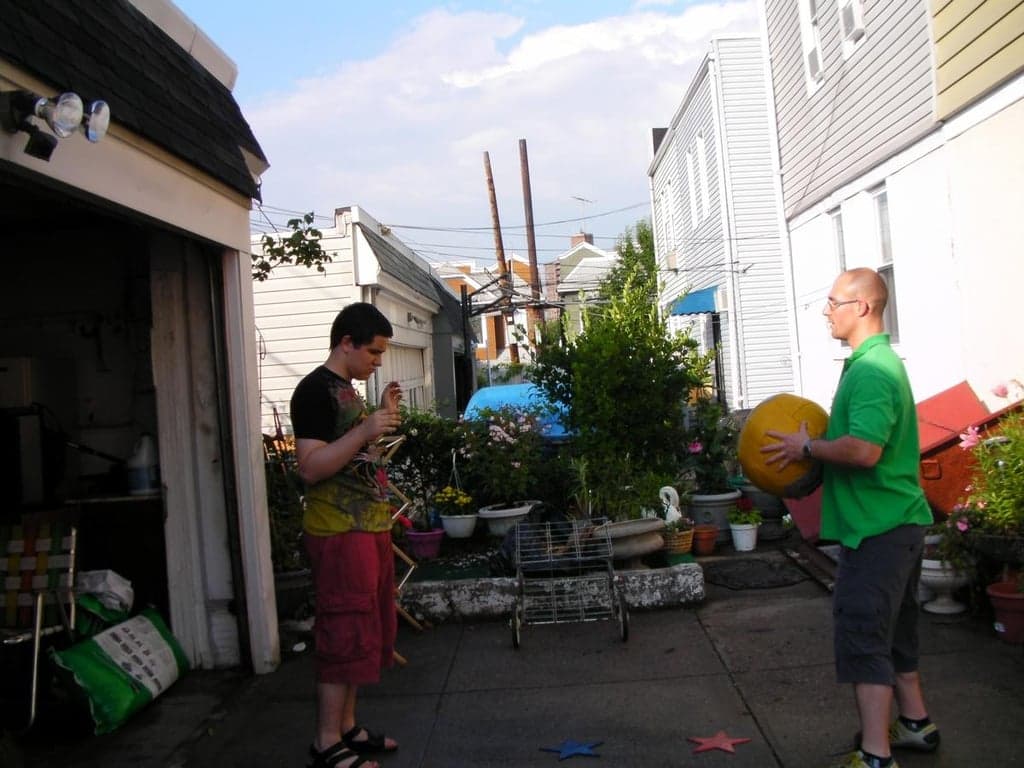
BySpecialNeeds.com EditorFrankie did not enjoy fitness activities when we first began our sessions about seven years ago. Prior to this, his most consistent activity was jumping up and down while hitting his chest with his hand and the more-than-occasional all out tantrum on the floor. A few days ago he pressed a 20-plus pound thick rope overhead and walked across the yard, smiling and laughing as he chucked it down to the pavement.
Fitness is the missing key in optimal development for individuals with autism. While it is becoming clear that the spectrum population is suffering from low muscle tone, weight gain (to the point of obesity), and poor gross motor skills, the integration of quality fitness and exercise programs for gyms, clinics, home, and school is still limited.
Creating fitness programs for the autism population, whether for one-to-one or groups, can provide a great array of benefits for physical, emotional, and cognitive health in addition to building social skills and self-esteem. A program should be appropriate, meaning it meets the needs of the individual. Below are seven concepts to keep in mind.
Fitness does NOT equal sports!
Many adaptive PE programs try to emulate or copy the goings-on of mainstream PE curricula. Team sport activities leave a LOT to be desired, including foundational movements (pushing, pulling, squatting, climbing, crawling, bending) and are often conceptually difficult for people with autism to understand or care about.
There are plenty of better options for both individuals and groups than a watered-down attempt at teaching the batting mechanics in baseball for half an hour while half the class sits or wanders around. Setting up activity stations or "obstacle" courses is a much more productive use of fitness or Adaptive PE time.
Don't Hesitate to Demonstrate
The majority of my athletes with autism are not auditory learners. If I provided the instructions, "Squat to the ball and look forward and make sure your toes are out and hold the ball and not like that! The other way!" we would only succeed in frustrating one another. Movement needs to be shown and felt many times over for independent mastery to occur.
Consider also that the individual may not know what you are asking him/her to do. Tina may have never seen an overhead medicine ball throw. Expecting her to somehow "automatically" know what you are talking about is a slight bit ridiculous. Performing the movement yourself and serving as a guide through prompting, or guiding the athlete through the activity is more productive.

Progress and Regress Accordingly
This is a BIG one. If an individual is having difficulty with an exercise or activity, it is important to know a simpler version. If Bill cannot perform an overhead press with the 10 lb dumbbells, try 5 or 7 lbs, or perhaps use a single, bigger object (a medicine ball, Sandbell, or sandbag) instead. Providing early exposure to success can drastically increase enjoyment of an activity, along with self-confidence.
When an exercise or activity is mastered and becomes easy for the individual, begin introducing variations, making the sequence more challenging. Adding time, repetitions, more resistance/weight, or more movement are all different ways to progress an activity.
Objects versus Objectives
I observed an adaptive PE teacher run her program. She had a class of high school students on the spectrum going through a circuit on different weight machines. When I asked why she was using them she replied "They were donated so we've been using them." Good thing nobody donated forks for the electric outlets.
Just because a piece of exercise equipment exists does not make it a good choice, particularly exercise machines. Yes, I know they take up the majority of space in most commercial gyms, but that is more marketing and ease-of-operation that it is "in the best interest of strength and health." With my athletes I favor spot markers, big ropes for swinging, soft medicine balls, Sandbells, Sandbags, and bodyweight movements including bear walks, hops, jumps, crawls, and climbing. All are much more fun, versatile, and less expensive than machines.

PLAY
Creative play is a significant deficit among the autism population. Can play skills be taught? Certainly. First, the foundation has to be developed. Having four or five new movements enables an individual to use them more creatively. For example, if Kim can swing a rope, do forward hops, and bear walk 10 yards, how many different ways can she combine the movements for her own activity course? This even works with nonverbal individuals when picture-based communication is used.
Prevail on Prepositions
Prepositions (in, on, under, over, right, left) are often difficult concepts to teach but easily incorporated into fitness programs. Fitness activities focusing on prepositions are ideal for the classroom and create a dynamic, active learning environment. Many are featured in my Autism Fitness in Your Classroom E-Book, available at http://www.Autismfitness.com.
Slow Steps to Lifetime Leaps
Fitness activities should be introduced at the pace and abilities of the individual. If this article does inspire you to introduce or add to an existing fitness program, remember that too much too soon can be overwhelming. Picking three to five new activities and beginning to teach them for less than a minute each over the course of a few days or weeks allows an individual to become tolerant of new instruction and familiar with the activity.
Fitness is the next frontier for helping the autism population to live the best life possible. Take these tips into consideration and start playing!
